

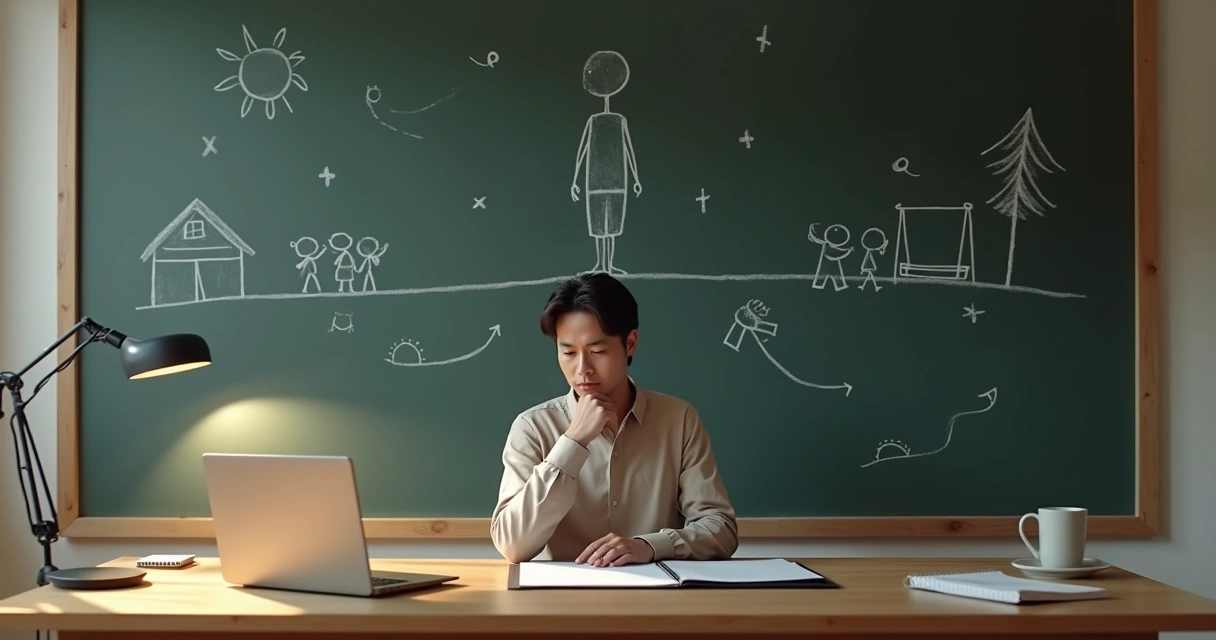
Many adult choices look rational on the surface. We compare options, weigh risk, and explain our reasons. Yet in our experience, a quiet layer often sits underneath all that thinking. It comes from childhood.
Childhood patterns are repeated emotional and behavioral responses learned early, then carried into adult life without much awareness.
A person may stay too long in a painful job, fear success, rush into relationships, or avoid honest conversations. From the outside, these choices can seem confusing. From the inside, they often feel familiar. That is the clue.
We think adult decision-making is shaped not only by logic, but by memory, emotional learning, and inner expectations formed in early life. A child learns, often in silence, what brings safety, love, approval, or rejection. Later, the adult keeps answering those same invisible rules.
We choose from memory more often than we notice.
How patterns are formed early
Children do not only hear lessons. They absorb moods, reactions, and emotional climates. If care was warm but unstable, they may grow into adults who crave closeness yet distrust calm. If affection depended on performance, they may become highly capable but unable to rest.
These patterns are not signs of weakness. They are adaptations. At one point, they helped us belong, stay safe, or avoid pain. The problem begins when an old strategy keeps running in a new stage of life.
We often see a few common roots behind adult choices:
- Approval was linked to achievement.
- Conflict at home made silence feel safer than honesty.
- Emotional needs were ignored or mocked.
- Caregivers were loving, but unpredictable.
- Responsibility came too early, leaving little room for play.
When these roots stay unconscious, they shape work, money, love, boundaries, and self-worth. People may call it personality. We would say it is often history still acting in the present.
In broader reflections on consciousness, we can better understand how past emotional learning keeps influencing present choices.
The hidden patterns that guide adult choices
Not every childhood pattern is dramatic. Some are subtle, even socially praised. Still, they can quietly control decision-making.
People-pleasing
If love felt linked to being easy, helpful, or good, we may grow into adults who say yes when the body wants to say no. This person often fears disappointing others more than betraying themselves.
A woman once told us she accepted every extra task at work. She looked committed. Inside, she felt panic whenever she thought of refusal. Her choice was not just about work. It was about an old fear of losing connection.
People-pleasing often begins as a child’s attempt to keep love stable.
Overcontrol
Some children lived in chaos. As adults, they make decisions only when every variable seems covered. They call it being careful. But many times, it is fear dressed as planning.
This can delay career changes, block intimacy, and create constant tension. The person is not only choosing control. They are choosing distance from uncertainty.

Hyper-independence
When asking for help led to disappointment, shame, or neglect, many children learned to rely only on themselves. Later, adult decisions become isolated ones. They reject support, hide needs, and confuse self-protection with strength.
This pattern may look mature, but it often carries loneliness. In our view, true maturity includes the ability to receive.
Self-doubt
Frequent criticism, comparison, or emotional invalidation can create adults who second-guess every step. They may have talent, but they do not trust their own reading of reality.
So they ask everyone. They postpone. They overthink. Then they miss timing, and the missed chance seems to confirm their fear.
Why emotions matter more than we admit
Research supports what many people feel in their own story. Research from the Centre for Economic Performance on childhood emotional health and adult life satisfaction points to a strong long-term link between early emotional development and later well-being. This tells us something simple but deep: childhood emotional life does not stay in childhood.
Another large dataset also points in the same direction. A multi-country preprint on positive childhood experiences and adult optimism found that supportive parental bonds and better perceived financial conditions in childhood were associated with greater optimism in adulthood.
The way we felt as children often becomes the way we predict the future as adults.
This matters because decisions are not made only from facts. They are made from expectation. If we expect rejection, we choose caution. If we expect support, we choose with more openness.
That is why themes related to emotional maturity can help us see that growth is not just about behavior, but about emotional re-education.
How these patterns affect work, love, and self-worth
Childhood patterns usually appear where choice meets emotion. Three areas make this easy to see.
In work, a person may chase titles to feel worthy, or avoid leadership because visibility feels unsafe. In relationships, they may cling, withdraw, test loyalty, or accept less than they need. In self-worth, they may measure value only by what they give.
We also notice that many adults choose according to hidden inner roles formed early, such as:
- The responsible one who carries too much.
- The quiet one who avoids conflict at any cost.
- The achiever who needs proof of worth.
- The caretaker who rescues others to feel needed.
These roles can become so normal that people stop questioning them. Yet they affect money choices, partner selection, career direction, and even daily routines.
In reflections about human valuation, we can widen the idea of value beyond output and start asking what kind of inner position our decisions come from.

How can we begin to change them?
Change starts when we stop asking, “What is wrong with me?” and begin asking, “What did I learn that I still obey?” That question opens space.
We usually suggest a sequence like this:
- Notice repeated choices that create pain.
- Name the emotion under the choice, such as fear, shame, guilt, or loneliness.
- Ask where that emotional rule first became familiar.
- Test a new response in a small, safe situation.
This is not about blaming the past. It is about ending automatic loyalty to it. At times, a brief pause before a decision can reveal more than hours of analysis.
Awareness breaks the spell.
We also find that simple inner questions help. Does this choice come from fear or truth? Am I seeking approval, safety, or alignment? Is this reaction adult-sized, or does it belong to an older wound?
For readers who want to keep reflecting on these themes, topics in practical philosophy and a broader look at childhood patterns can support deeper self-observation.
Conclusion
Adult decision-making is rarely shaped by logic alone. Early patterns teach us what feels safe, what feels risky, and what we think we must do to deserve love or respect. Many of our present choices still answer old emotional conditions.
When we see the childhood pattern clearly, we gain freedom to choose differently in adult life.
That freedom does not arrive through self-judgment. It grows through honest attention, emotional clarity, and repeated new choices. A pattern may be old. It does not have to be permanent.
Frequently asked questions
What are childhood patterns in decision-making?
Childhood patterns in decision-making are emotional habits and beliefs formed early in life. They develop from repeated experiences with care, conflict, approval, fear, or neglect. In adult life, these patterns can influence choices without our full awareness.
How do childhood habits affect adults?
Childhood habits affect adults by shaping how we react to stress, relationships, work, and uncertainty. A person may avoid conflict, seek constant approval, or struggle to trust others because those responses once helped them feel safe when they were young.
Can childhood experiences shape career choices?
Yes, childhood experiences can shape career choices. Adults may choose careers to gain recognition, avoid exposure, feel secure, or repeat family roles. Some pursue high achievement to feel worthy, while others stay small because visibility feels emotionally unsafe.
How to change negative childhood patterns?
We can change negative childhood patterns by noticing repeated painful choices, identifying the emotions behind them, and tracing those reactions back to early experiences. With awareness, reflection, and new responses practiced over time, old patterns begin to lose force.
How to identify my childhood decision patterns?
We can identify childhood decision patterns by looking at recurring problems in love, work, money, and self-worth. Ask what kind of situations trigger strong reactions, what fear sits underneath, and whether the response feels older than the present moment. Repetition is often the clearest sign.